

Playing with CPP funds – working Canadians’ retirement dollars


PM Mark Carney and the Liberal government have been playing with Canada Pension Plan (CPP) funds, and there appears to be few Canadians noticing this – the government-subsidized mainstream media is not reporting the facts. Technically, the government is not crossing the line and the PM and ministers are quick to state that the investment decisions involving CPP funds are independent of any government direction. However, there are many behind the scenes activities being orchestrated by our global-banker-turned-PM that should alert working Canadians about their retirement savings.
The CPP turned 60 years old in January, and today, working, taxpaying Canadians recognize the CPP as a state-managed, forced retirement savings plan. That is only partly correct. The money collected from working Canadians and their employers and deposited into the CPP is actually managed by the Canada Pension Plan Investment Board (CPPIB). The CPPIB was established in 1997 as an independent body, apart from the federal government, so as to be unencumbered by governing politicians and their political agendas when making investment decisions for Canadians. The governance of the CPP was intentionally designed to prevent political interference or undue influence.
By law the CPPIB is mandated to maximize long-term returns without undue risk of loss and it is legally bound by a fiduciary duty to act solely in the best financial interests of contributors and beneficiaries – that is in the best interests of working Canadians, and those retired Canadians who made payments throughout their working lives. On its website, the CPPIB states: “Our purpose is to provide a foundation for more than 22 million Canadians to help build their financial security in retirement.” The board clarifies up front: “We are accountable to Parliament and to federal and provincial ministers, however, we operate independently guided by an independent Board of Directors.”
Learn more about the CPP in this informative Fraser Institute article, “Canadians continue to misunderstand the CPP”
Today the CPPIB manages the investment of a considerable amount of money for working Canadians’ retirement savings – $780.7 billion, as of December 31, 2025. Earlier this year, largely due to the PM’s piquing anti-American posturing, Canadian mainstream media made much of the fact that CPP funds are predominately invested in the U.S. CBC News was critical that the Carney Liberals were promoting “Buy Canadian” while Canada’s top pension funds were heavily invested south of the border. (As an aside, it is amusing that CBC was silent regarding the PM’s own investments which are more than 90 per cent invested in the U.S.).
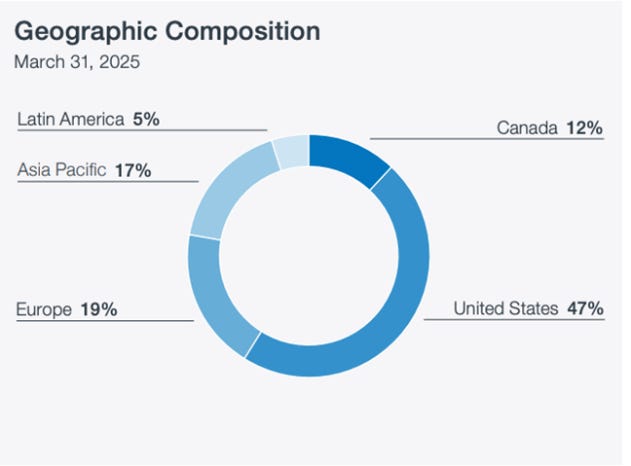
CBC reported only 12 per cent of CPP assets were invested in Canada while 47 per cent, a total of $366.9 billion, were invested in the U.S. The state broadcaster went as far as conducting an analysis of Canada’s largest pension funds (a.k.a. the “Maple Eight”) and factored there is more than a $1 trillion of Canadian pension fund investment in the U.S.
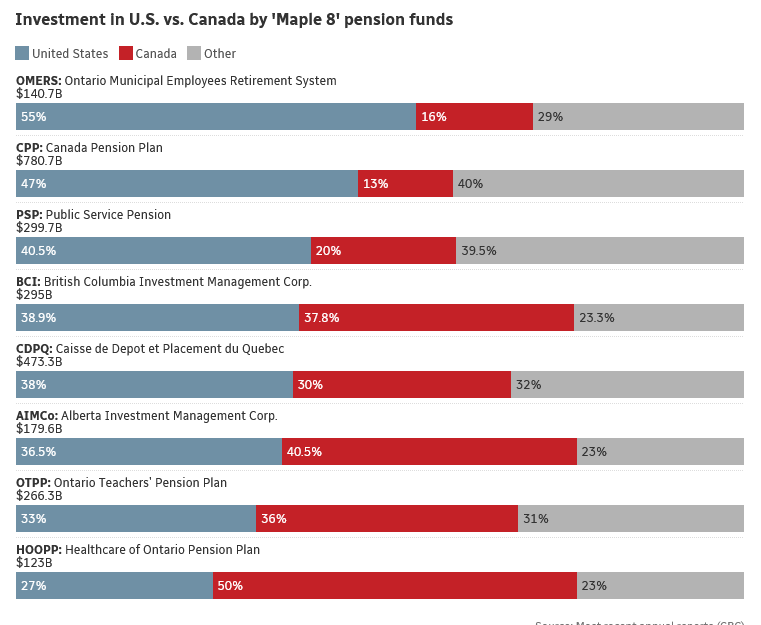
The fact that the CPPIB is bullish on the American market where it is making healthy returns for Canadians, in spite of the Liberals political agenda, is a reassuring sign of its independence.
However, there are other activities that have not been given headline news in Ottawa that are cause for concern for working Canadians and retirees. To give this matter the necessary context, it is important to recognize that the key players in the Carney government are career financial and institutional investment experts who are intimately knowledgeable about the management of pension funds. Aside from PM Carney’s own banking expertise, there is the PM’s Chief of Staff Marc-Andre Blanchard, former senior executive with Quebec’s pension investment fund CDPQ, PM-appointed clerk of the privy council Michael Sabia, a former president of the CDPQ, and recently named Ambassador to the U.S. Mark Wiseman, former Goldman Sach and Blackrock executive and former chief executive of the CPPIB. The point that is belaboured here is that the PM and his inner circle know pension funds and are astute with their investment possibilities.
There is also another close relationship that the PM has with a board member of the CPPIB, which government-sponsored main street media has failed to disclose. Independent investigative journalist David Krayden recently exposed that Mark Carney’s sister-in-law’s significant other is Mark Evans, appointed to the CPPIB in 2019 by Justin Trudeau’s cabinet. Krayden connects the dots on the personal relationships and their significance:
“Tania Fox (BFF w Ghislaine Maxwell), Mark Carney’s sister in law, is “intimate” with Mark Evans (Daily Mail) who was appointed to Canada’s CPP Board of Directors. Evans is involved in making decisions on the CPP portion (everyone in Cdn pension) of the $2 trillion Maple Pension “green de-risking” strategy [scam] Carney is selling to the UAE and India which will dramatically enrich Carney’s Brookfield portfolio held in “blind trust”.”
Other important career notes for Evans is that he held a Goldman Sachs management position, and worked in Asia specializing in the China market. Verily, it all makes for a small world.
Since Carney became PM, he has made repeated mention of the attractiveness for the CPP funds to be invested in the country’s “nation-building” projects. Drawing on his recent experience heading up the GFANZ global finance initiative, Carney has been repeatedly referring through 2025 to “catalyzing investments” in Canadian infrastructure, energy, and domestic projects such as the EV supercharging stations and the highspeed “national” rail project from Montreal to Ottawa.
In response to the PM’s overt overtures, the CPPIB’s chief executive officer John Graham was quoted in a BNN Bloomberg opinion piece as saying he saw value in the government’s large-scale domestic infrastructure projects. In a September speech to a Toronto financial audience Graham shared that the board is “keen” on the PM’s projects, stating, “When Canada offers the right opportunities, we step in. These days we are looking to invest in nation-building projects: large scale infrastructure and energy systems.”
The Carney Liberals have been actively working on how to leverage CPP dollars for their political initiatives. Whether it is inadvertent or intentional is a question of debate, however the PM is constantly referring to the CPP fund as if it were his pool of money to manage. Canadians have caught a glimpse of this with the PM’s globetrotting announcements. In his fall trek to the United Arab Emirates, Carney promised that his finance minister would lead a delegation of Canadian pension fund managers to Abu Dhabi to develop new investment opportunities in the country. In India, after Carney had closed-door meetings with PM Narendra Modi, the Indian leader was very pleased to announce, “Canadian pension funds have invested $100 billion in India.” The CPPIB had not yet made public the decision to invest in India; independent media would later report that about $30 billion of CPP funds were being invested and the $100 billion pension funds were going towards Indian infrastructure, renewables, logistics, and markets.
It was also reported in January that finance minister Francois-Philippe Champagne met on Bay Street with the managers of the Maple Eight funds, the country’s largest funds with assets totaling more than $2.6 trillion. Champagne’s objective was to encourage the fund managers to invest in domestic projects.

The minister was careful in his remarks to suggest that he was not arm-twisting, “We have had a recent discussion with all of them to say … can we do more together, respecting that they are independent but at the same time looking at opportunities.” He went on to share that the discussions between the government and the fund managers are now formally scheduled, “We have created a meeting point every quarter that we’re going to be sitting together … looking at the kind of projects that could lead them to invest more in Canada.” The minister’s spokespersons were quick to point out that the government is making no suggestion that it will impose foreign ownership limits on RRSPs and pension funds and regulate or force pension funds to “Buy Canadian.” Still, Champagne conveyed there was much to talk about regarding pension fund investment.
Though Canadians may not be aware of the government’s actions with regard to the CPP funds, the troubling developments have not gone unnoticed by MPs. The last word for this column goes to British Columbia MP Tamara Jansen who in early February broached this very subject in the House of Commons. Jansen’s comments in Parliament must serve as a warning about the independence of the CPPIB and its management of CPP funds:
“The Prime Minister talks as though pension savings could be a tool for government’s nation-building agenda. But is that what Canadians voted for? Did they elect him to find a clever way into the CPP cookie jar…. That’s your money and it was deliberately placed out of politicians’ reach years ago, supported by the Conservatives, precisely so that they could not redirect Canadians’ retirement savings towards political priorities. Pension funds were designed to be protected from political interference. Their job is to invest responsibly, not to chase ideological projects dressed up as policy.”
Jansen went on to say,
“Here is my key point. We know that if a project is too risky it shouldn’t qualify for pension investment. But with fancy footwork this government could de-risk it on the back of the taxpayer and suddenly the project looks safe enough on paper. The spreadsheet improves, projected returns stabilize – not because the risk disappeared but because middle class Canadians are now holding the bag….”
A TikTok post of MP Jansen’s comments has gone viral in social media — perhaps reflective of working Canadians’ growing concerns for their CPP.
Postscript:
PM Mark Carney, Brookfield Asset Management, and the CPP funds
It is a tangled web of activities that tie global-banker-turned-PM Mark Carney and Brookfield Asset Management with CPPIB operations and investment decisions regarding Canadians’ CPP retirement funds. A few independent journalists have helped to untangle the story and this postscript provides links to their media.
The scandalous financial activities that tie Brookfield to the CPP funds involve “de-risking investment strategies, something that global banker Mark Carney knew intimately; indeed, Carney wrote new chapters in the globalists’ investment handbook on de-risking. Essentially, as financier Robin Hillier describes it,
“the de-risk investment model attracts private investors by shifting a large portion of the downside risk unto public balance sheets. The consequence is that when the project under-performs during the long development phase the public fully absorbs the validity while the private capital remains protected.”
To use Brookfield investors as the example. Investors would be attracted by profitable returns to invest in Brookfield’s green transition funds, which would be invested in a myriad of green energy projects (some initiated and/or managed by government). It really does not matter whether these projects are profitable as Canadian pension funds would be invested over the term of the project and those public funds would absorb the losses. So, Canadians’ public pension money “de-risks” Brookfield’s private investments for the benefit of Brookfield investors, and the government’s green projects are fully backstopped by Canadians’ pension funds.

David Simieritsch of the independent news show Moose on the Loose was the first to connect all the dots on this activity back to Mark Carney. In his exclusive video Carney’s FAMILY Is Steering Canada Pension Plan BILLIONS!?, Simieritsch explains, “I show how Mark Carney and his family is going to influence the Canadian Pension Plan. This is about as bad as it sounds…” He links Carney and his wife, and her sister Tania, with her partner Mark Evans, who is a Goldman Sachs financial executive – and an appointed CPPIB director. This video is very informative to understand the Carney family connections and how “the family” can mobilize Canadian retirees’ money in the CPP for the Liberals net-zero green grift programs and projects.

David Krayden does an excellent job of explaining the “massive financial scam that is happening to you in broad daylight.” Admitting that the de-risking strategy is a complicated process, Krayden boils it down for Canadians: “It is all about financing Brookfield. The corruption is waist-deep, elbows-deep, perhaps neck-deep.” He features the investigative work of Robin Hillier in his video: SHOCKING: Carney and the Great Green Con & Pension Plan Scandal. (The pension plan scam segment of this show is approximately 20 minutes in length.)
“It is financial chicanery. Circular investment from pensions and tax dollars into the Canada green fund which is boosting the Brookfield green funds. He wants these countries also to participate in investing in the fund so the pensions capital “de-risk” it for the countries because our pensions make the green funds less risky.” – David Krayden
Krayden also raised this issue again in a X post: “Pensions again! Mark Carney can’t stop talking about our Canadian pensions! Carney is flying to cities where there are CPP Board satellite offices and making announcements re using our pensions as “capital” in each one, mostly to de-risk his green scams which are tied to Brookfield….”

Robin Hillier is a Calgary real estate businessman who produces Hillier Investigates. His show is described as “hard-hitting political analysis, economic breakdowns, and deep dives into the stories Canada’s mainstream media won’t touch. From federal budgets and pension funds to de-risking schemes, green-transition financing, and government accountability, this channel exposes how power really works in Canada. Clear, fact-driven, unapologetic truth.”
Hillier has produced two videos that do an exceptional job of explaining Mark Carney’s conflicts with the Brookfield de-risk strategy. He reviews Carney and his roles as global banker in the Davos backrooms, as UN special envoy leading GFANZ (Glasgow Financial Alliance for Net Zero) – the very organization that financial institutions abandoned after U.S. congressional hearings into anti-competition regulations identified GFANZ work as that of a “globalist green cartel.” Hillier also looks at Carney’s conflicts of interest as chair at Brookfield and manager of Brookfield’s premier green transition fund, while he was serving in Ottawa as a special economic advisor to PM Justin Trudeau.
Hillier’s take on Carney is blunt: “That is a snake oil salesman who is sucking away capital in order to completely protect private investors of which he has over 5oo investments.” He explains the details in two must-see videos:

There are countless backstories that reflect on how the global investment firm Brookfield has its tentacles everywhere, from investment deals in China and Qatar to major pipeline investments in the U.S. Here are two recent activities that were in the news that unfolded on Canadian soil.
In September 2024, Toronto-based business and tech news organization The Logic carried an exclusive: Brookfield in talks with Canadian pensions to create new $50B fund for domestic assets. It was proposed at the time that Brookfield would manage pension fund monies and invest them in select government infrastructure initiatives. The breakdown of investment dollars was $36 billion in commitments from a group of Canadian pension funds (including CPP funds), $10 billion from the federal government, and Brookfield would invest $4 billion into the fund. Brookfield investors would be leveraging the money of Canadian retirees and taxpayers!
The rub with this investment scheme was that Mark Carney was chairing Brookfield at the same time as he was advising the governing Liberals. The Brookfield proposal came just after Finance Minister Chrystia Freeland (Carney’s close family friend) had advised the Bank of Canada governor to open discussions with the country’s largest pension funds on ways more pension monies can be invested in Canadian projects. The finance department stated at the time that the minister was looking on how to “catalyze greater domestic investment opportunities for Canadian pension funds.” So, it appears that Freeland was setting the table here for Brookfield to administer pensioners’ funds in the government’s chosen infrastructure projects. (Fortunately, this has not taken place – yet.)
The second story made headlines in early March when BC MP Aaron Gunn reported out that the Liberal cabinet ministers had denied Brookfield Renewables from sending Powell River BC hydroelectric power to the U.S. instead of being used locally. In early February, Canada’s energy regulator rejected an electricity permit request after local residents sent petitions and letters in protest of the Brookfield-American power deal. The final decision rested with Ottawa and word has leaked that the federal cabinet accepted the regulator’s negative recommendation. Aaron Gunn explains the current situation in this X post. The MP stated, “Canadian resources should go to benefiting the Canadian people first and our national interests first, especially given the current trade war with the U.S.” Gunn vows to expose Brookfield’s investment activities that are offside with Canadians’ interests.
Finally, Canadians should watch for where Brookfield’s Global Transition Fund II may show up in government projects and, more importantly, with any pension plan investments. This is Brookfield’s $20-billion investment fund designed to accelerate the development of the global net-zero-emissions economy with a variety of government-planned green energy programs. Another interesting point about Brookfield’s green schemes is that Mark Carney himself raised a record $15 billion for the company’s initial international green transition investment fund. Evidently, Carney is adept at pitching for investment in net-zero green technologies, including renewable energy, carbon capture, and every product from battery storage to heat pumps.
To stay informed on this subject and other topical news from Ottawa, Canadians should be following these independent journalists’ work: Moose on the Loose (also on X), Krayden’s Right News (on X), and Hillier Investigates (on X).